“My brain is misfiring, not revealing my character.”
This shift reduces fear dramatically.
2.
Imagine a thought suddenly pops into your head: “What if I jump in front of this train?” or “What if I accidentally offended my friend when we were talking earlier?” It’s unsettling, but you brush it off and move on.
Now imagine that same thought won’t leave.
For someone with OCD, the anxiety comes from trying to make sense of the thought—“Why did I think this? Here are examples that commonly appear in OCD:
1. A sudden, unwanted mental ‘shock’
The thought appears instantly and feels jarring or disturbing.
2. Existential Intrusive Thoughts
“What if none of this is real?”
“What if I lose control of my mind?”
Obsessive questions about consciousness, reality, and life meaning.
Important clarification
People with OCD do not want these thoughts, do not act on them, and are usually the least likely individuals to behave in harmful or immoral ways.
1.
These thoughts are typically violent or disturbing and are completely at odds with the individual's character or moral code. In reality, intrusive thoughts are involuntary, unwanted mental events that say nothing about a person’s morals or intentions.
Intrusive thoughts are unwanted mental images, impulses, doubts, urges, or scenarios that pop into the mind without permission.
However, these thoughts can cause significant distress and should be addressed with the help of a mental health professional.
3. These thoughts are symptoms—nothing more.
The more we talk about intrusive thoughts openly, the less power they have. Awareness creates understanding. Understanding creates distance. Distance creates peace.
Intrusive thoughts do not need to control your life.
Despite the challenges they present, with professional help such as cognitive-behavioral therapy or medication, individuals with OCD can manage these intrusive thoughts and lead fulfilling lives. Exposure and Response Prevention (ERP) principles
ERP is a widely supported psychological method. While only trained therapists can deliver formal ERP, individuals often independently use ERP-inspired strategies such as:
allowing the thought without ritualizing
resisting compulsions or avoidance
stepping closer to the fear instead of escaping it
This retrains the brain to stop treating harmless thoughts as threats.
8.
What makes them so powerful in OCD is the cycle of anxiety, doubt, and compulsions, which reinforces their significance over time.
If you’re struggling with distressing intrusive thoughts, it doesn’t have to be this way forever. Soon, other thoughts begin to pile on: “Did I mean to hurt my friend’s feelings?”“What if I secretly wanted to upset them?”—even though you know deep down that’s not true.
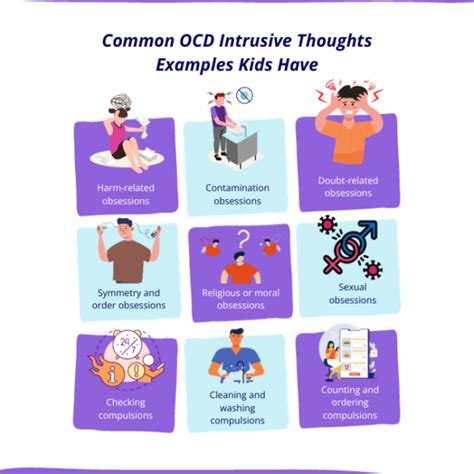
It's important to understand that these are not quirky habits, but are often symptoms of an underlying condition that may require professional help to manage effectively. Religious Obsessions (Scrupulosity)
This refers to a form of OCD where individuals experience persistent, intrusive fears related to religion and morality.
Lifestyle practices that reduce overall anxiety
While not cures, these habits improve mental clarity:
regular sleep
exercise
reducing stimulants
journaling
structured routine
limiting stress triggers
These help reduce the intensity of intrusive thoughts.
9.
It's important to understand that having these thoughts does not mean the person is dangerous or unstable; it's simply a symptom of their disorder. Religious or Moral Intrusive Thoughts
“What if I accidentally offend God?”
“What if I committed an unforgivable sin without knowing?”
Compulsively analyzing whether they are morally ‘good enough.’
4.
Allow the thought instead of fighting it
Counterintuitive, but effective:
Do not argue with the thought.
Do not try to make it go away.
Do not debate its meaning.
Instead: Acknowledge → Accept → Let it pass naturally.
Resistance feeds the thought. They stick, looping endlessly in the mind, and feel urgent and overwhelming.
Emotional and physical exhaustion
Constant mental checking, avoidance, analysis, and fear drain energy and increase anxiety.
7. Building emotional resilience
People often improve when they:
manage stress
improve sleep
create routine
reduce isolation
talk openly with trusted people
The brain becomes less reactive under lower stress.